What Glacial Till Means for Rockford Homeowners
If you live in Rockford, your home sits on ground shaped by ancient ice. Thousands of years ago, glaciers pushed through northern Illinois and left behind a dense, unsorted mixture of clay, silt, sand, and gravel known as glacial till. Unlike clean sand or uniform clay, till is a stubborn blend that traps water in unpredictable ways. Some pockets drain quickly while others hold moisture like a sponge, and that inconsistency is exactly what makes foundation problems so common here.
The practical result is that water does not simply soak away after a storm. It percolates slowly through the till, builds hydrostatic pressure against your foundation walls, and looks for the smallest opening to get inside. Over time, that constant pressure contributes to Foundation Waterproofing challenges that are unique to our region. Homeowners in nearby Loves Park and Machesney Park deal with the same soil profile, which is why basement leaks Rockford residents report so often trace back to the ground itself.
Why Thaw Water Is the Quiet Culprit Behind Basement Leaks
Winter in the Rockford area brings frozen ground and snow cover. When temperatures climb in late winter and early spring, two things happen at once: the snowpack melts and the top layer of soil thaws while the deeper ground is still frozen solid. That frozen layer acts like a concrete floor, so meltwater cannot drain downward. Instead, it spreads sideways across the surface and through the thawed topsoil, pooling against foundations and seeping into window wells, cracks, and joints.
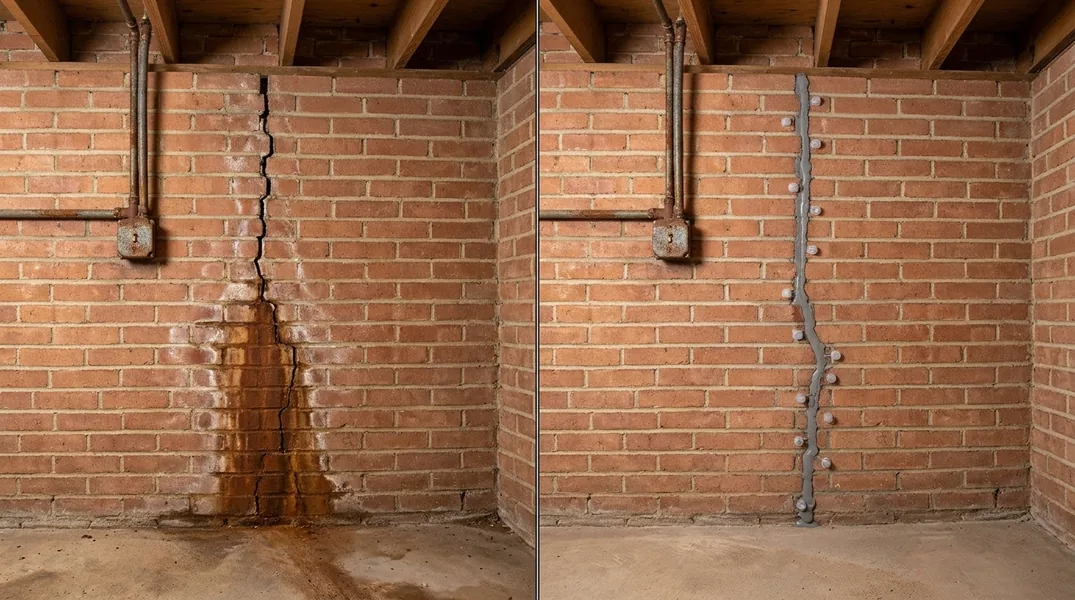
This thaw water foundation problem is one of the most reliable predictors of spring basement leaks in our region. Many homeowners notice dampness, efflorescence (the white chalky residue on walls), or actual standing water only during the thaw, then forget about it by summer. But each freeze and thaw cycle widens existing Illinois foundation cracks a little more. Water freezes inside a hairline crack, expands, and pushes the concrete apart. Repeat that dozens of times over a winter, and a small crack becomes a real pathway for water.
Soil Movement and Illinois Foundation Cracks: What to Watch For
Glacial till does not just hold water; it also expands and contracts with moisture changes. When the soil is saturated after heavy rain or a thaw, it swells and pushes against foundation walls. When it dries out in a hot summer, it shrinks and pulls away, leaving gaps around the foundation. This cycle of soil movement puts stress on concrete and masonry, and it is a leading cause of the stair-step cracks in block walls and the vertical cracks in poured concrete that we see across Rockford.
You do not need to be an engineer to spot warning signs. Look for cracks wider than a hairline, doors and windows that suddenly stick, gaps where the wall meets the floor, or a musty smell in the basement. Any of these suggest that soil movement and water pressure are already working against your home. A professional assessment can tell you whether the issue is cosmetic or structural, and it is far cheaper to address early than after a wall has bowed. If you are unsure what you are seeing, a free estimate is a sensible first step before problems grow.
Basement Waterproofing Near Me: Solutions That Match Rockford Soil
Because glacial till and thaw water create pressure from the outside, effective solutions have to manage that water rather than just patch the symptom. For many homes, an Interior Drain Tile System is the most practical answer. It captures water that reaches the footing and routes it to a sump pump before it can rise into your living space. This approach works well in finished and unfinished basements alike and can usually be installed without excavating the yard.
In other cases, especially where exterior grading or foundation damage is severe, Exterior Basement Waterproofing is the better fit. That means exposing the foundation, sealing it, and installing drainage and membrane protection on the outside. Many homes benefit from a combination of approaches, and the right answer depends on your soil conditions, foundation type, and how water is currently entering. A thorough Basement Waterproofing plan should always start with diagnosing the actual path water takes, not with a one-size-fits-all product.
Basement Waterproofing Cost in Rockford: What to Budget
Homeowners understandably want to know what waterproofing will cost before they commit. The honest answer is that pricing depends on several factors: the length of wall involved, whether you need interior drainage, exterior work, or both, the condition of your foundation, and whether a sump pump or other components are included. A small crack injection is a modest project, while a full perimeter drain tile installation is a larger investment. Neither is a place to cut corners, because a failed repair means paying twice.
The best way to get a realistic number is an on-site evaluation. Rockford Waterproofing provides clear, written estimates so you know exactly what is included and why each item is recommended. It also helps to ask about warranties and long-term performance, since the goal is to solve the problem permanently rather than mask it for a season. Call (815) 706-4084 to schedule a visit, or reach out through the website to request your free estimate and get a plan built for your specific soil and foundation.
Looking for a professional basement waterproofing contractor in Rockford? Rockford Waterproofing responds fast for all your basement waterproofing needs.
Get a Free QuoteOur services: Basement Waterproofing · Interior Drain Tile System · Exterior Basement Waterproofing