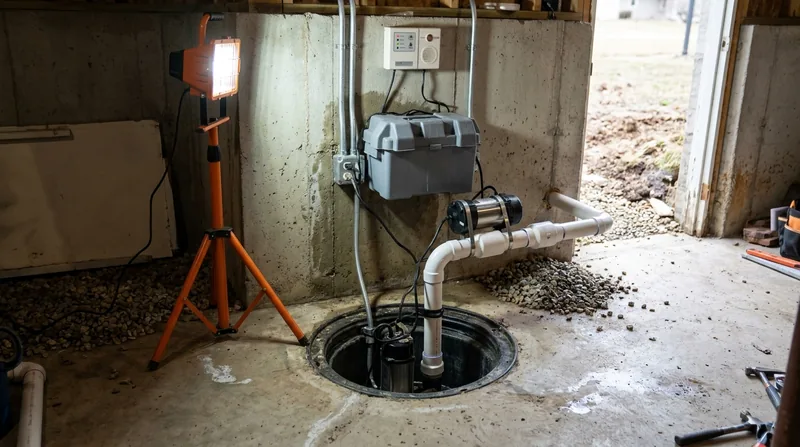




If you have ever watched a summer downpour turn Rockford's low lots into standing water, you know the sound of a sump pump running nonstop. Now picture the power going out at 2 a.m. during that same storm, or a hard February freeze knocking the grid down while the frost line heaves and the water table pushes under your slab. A Battery Backup Sump Pumps in Rockford system is the second pump that keeps your basin dry when the primary pump has no electricity to run. We size the battery, charger, and alarm to your existing pit, then test the whole setup under load. If your pit is still running on a single pump with no backup, start with a sump pump installation and replacement review before the next storm season.
Why Rockford Basements Need a Backup Pump, Not Just a Primary
Rockford sits on Wisconsin glacial till and silt over dolomite bedrock, and the water table runs high along the Rock River floodplain and in the creek bottoms near Keith Creek. The 1880s to 1930s brick and frame homes on the East and West sides, Downtown, and Haight Village often still drain through old clay footing drains that clog and back up. When the primary pump quits during an outage, that water has nowhere to go but into the basement.
- Spring thaw sends snowmelt into the low lots while the ground is still frozen and cannot absorb it.
- Summer downpours overwhelm footing drains in Southeast Rockford and along Keith Creek faster than a single pump can cycle.
- Long, hard winters heave the frost line and can shift a discharge line loose or freeze it solid.
- Older stone and brick foundation walls seep under hydrostatic pressure the moment the basin overflows.
A backup pump does not fix a bad drain tile system, but it buys you the hours you need to keep the floor dry until power returns.
Key info: In the 2019 and 2020 Rock River floods, homeowners in Downtown and Haight Village reported pumps running for days. A battery backup sized for 8 to 12 hours of runtime is the minimum we recommend for those low blocks.
For the official record on floodplain maps and local building rules, the City of Rockford's community development office publishes permit and floodplain guidance at rockfordil.gov.
How We Install a Backup System in a Rockford Basement
Every install starts with a look at your existing sump basin, the check valve, and the discharge line. We measure pit depth and diameter, confirm the primary pump's float travel, and check where the discharge exits the foundation. Then we match the battery and charger to the actual volume your pit takes on during a storm.
- We inspect the basin and confirm the primary pump and check valve are working before adding a backup.
- We set the backup pump on a separate float so it only runs when the primary fails or the water rises past its trigger point.
- We mount the battery and charger on a shelf or wall bracket clear of floor splash and test the charge circuit.
- We wire a high-water alarm that sounds before the basin tops out, not after.
- We run a load test by filling the pit and timing the backup pump's cycle, then log the runtime.
If your pit is undersized or the discharge line lacks a proper freeze slope, we flag that before the backup goes in, because a backup pump pushing into a frozen line is no backup at all.
Key info: A split-level in Loves Park with a shallow poured basin and a discharge line that exits at grade is a common setup we see. We add a freeze-resistant discharge run and a battery sized for the pump's actual amp draw, not a generic off-the-shelf unit.
If the pit itself is the weak point, pair the backup with an interior drain tile system so the basin receives water evenly instead of in surges.
Backup Pump Approaches We Use in Rockford
Not every basement needs the same hardware. A 1920s West Side home with a stone wall and a deep basin has different demands than a 1990s colonial in Roscoe with a poured walkout. The table below shows the approaches we install and where each one fits.
| Approach | Description | Best for |
|---|---|---|
| Battery backup pump and charger | A DC pump on a separate float with a charged battery and wall-mounted charger. | Homes with a working primary pump and a standard pit. |
| Combination primary and backup unit | A single assembly with an AC primary and DC backup in one housing. | Tight pits in Cape Cods and brick ranches where space is limited. |
| High-water alarm add-on | A float-triggered alarm that sounds before the basin overflows. | Any basement, especially finished spaces and storage rooms. |
| Extended runtime battery bank | Larger battery capacity for longer outages and higher inflow. | Low lots near the Rock River floodplain and creek bottoms. |
| Discharge line and freeze protection | A sloped, insulated discharge run with a proper check valve. | North-side subdivisions in Loves Park and Machesney Park. |
We pick the approach after we see the pit and the discharge route, not from a catalog page.
Battery Backup Sump Pumps Cost in Rockford: What to Expect
Most battery backup installations in Rockford start around $900, and that figure covers a standard DC backup pump, a charged battery, a charger, and the alarm. The number moves up when the pit needs modification, when the discharge line has to be rerouted or insulated, or when you want extended runtime for a low lot near the Rock River. A combination primary and backup unit usually costs more than adding a backup to a healthy existing pump.
Access matters too. A basement with a finished ceiling and a tight pit takes longer to work around than an open mechanical corner. We quote after we see the pit, the discharge route, and the panel, because guessing from a photo leads to change orders. Get two or three estimates and compare what each one includes: battery size, charger type, alarm, and whether the discharge line is part of the scope.
Our full breakdown of line items and options is on the pricing page, so you can see how the $900 starting point builds out.
Finding a Battery Backup Sump Pumps Contractor Near Me in Rockford
Ask for the license and insurance certificate before anyone touches your pit, and confirm the policy covers basement work, not just general handyman tasks. Get at least two written estimates that list the battery model, the charger, and the alarm separately. Ask for references from Rockford or Loves Park homeowners with the same foundation type and pit depth as yours. Permits are commonly required when work alters the drainage or the sanitary connection of a sump discharge, so check with the City of Rockford building department before the crew starts, since thresholds vary by jurisdiction. If your home is in a subdivision with HOA rules, confirm whether exterior discharge routing needs approval.
Reach out through our contact page to schedule a free basement inspection and a written estimate.
Battery Backup Sump Pumps in Rockford: Pricing Guide
| Service | Price | Details |
|---|---|---|
| Standard battery backup install | Starting at $900 | Includes DC backup pump, charged battery, charger, and high-water alarm for a standard pit. |
| Combination primary and backup unit | Starting at $1,250 | Single housing with AC primary and DC backup, suited to tight pits in older Rockford homes. |
| Extended runtime battery bank | Starting at $1,450 | Larger battery capacity for low lots near the Rock River floodplain and creek bottoms. |
| Discharge line and freeze protection | Starting at $350 | Sloped, insulated discharge run with check valve for north-side subdivisions and cold winters. |
| Complex or large-scale job | On estimate | Pit modification, finished ceiling access, or multiple pump zones need an on-site look first. |
| Estimate | Free | Response within 24h at (815) 706-4084, no obligation to book. |
Indicative pricing, the exact cost depends on square footage, finish, and site access. Free personalized estimate within 24h at (815) 706-4084.


